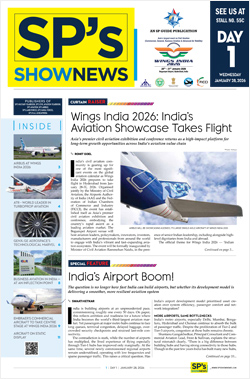





India is a market where turboprops are not only relevant, but indispensable for connecting communities efficiently and sustainably
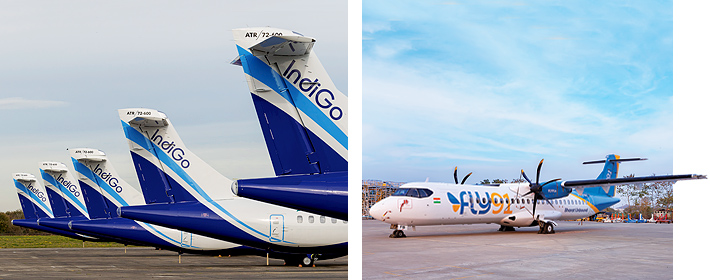
Over the past 45 years, ATR has built a unique expertise, providing 200 airlines in 100 countries the most fuel-efficient, cost-effective regional aircraft, ideally suited to serve short sectors profitably and deliver inclusive connectivity for communities.In India, our presence spans over 25 years, during which ATR aircraft have become an essential backbone of regional connectivity and a trusted choice for operators serving the country's diverse and fast-growing markets.
Throughout these decades, we have seen first-hand the strong demand for affordable and dependable regional air travel across India's vast network of tier-2 and tier-3 cities. And recently, the evolutions we've seen proved remarkable. India is undertaking one of the world's most ambitious expansions of aviation infrastructure. Under the government's UDAN scheme, more than $2 billion have already been invested to support the mission of "letting the common citizen of the country fly." And the results are absolutely impressive: over the past decade, this effort has more than doubled the number of operational airports and enabled the launch of nearly 650 new routes, with the scheme now extended for another decade.
Regional mobility is in our DNA. We want to contribute to that ambition, because we truly believe that everyone should have access to all the opportunities of a connected world, and regional aviation is crucial to offer just that. That's why we created the 'Mobility Monitor', a data-driven platform designed to map real mobility behaviour, using real travel patterns of over 20 million anonymous Indian travellers. Thanks to this platform, we can now quantify and visualise this demand with unprecedented clarity. The tool confirms what decades of operational experience have already shown: India is a market where turboprops are not only relevant, but indispensable for connecting communities efficiently and sustainably. Here are the main findings revealed by this brand-new analysis, which we'll unveil during the 2026 edition of Wings India.
UNLOCKING INDIA'S TIER-2 AND TIER-3 POTENTIAL
More than 90 per cent of India's domestic trips cover less than 740 km (400 nautical miles), a distance where turboprops outperform jets on efficiency, economics, and environmental impact. This makes ATR aircraft the natural choice for linking India's fast-growing tier-2 and tier-3 cities, communities that increasingly demand reliable, affordable, and frequent air travel.
Today, only around three per cent of India's domestic inter-city mobility market uses air travel, despite the country generating 4.6 billion journeys per year across all modes. This low penetration highlights just how much potential exists in these markets. Our MobilityMonitor, a platform designed to analyse real mobility behaviours, shows that approximately 425 million people currently live within 90 minutes of an airport, about 30 per cent of the population, and that when travellers fall within this access range, demand for air travel can increase up to threefold.
With the government planning to expand India's airport network to over 230 airports by 2030, regional routes are multiplying faster than ever. ATR forecasts up to 900 new city pairs emerging in this decade, overwhelmingly between tier-2 and tier-3 cities. For millions of Indians, expanded access will mean gaining a viable alternative to long journeys by road or rail, and in many cases, gaining convenient access to the national and international air network for the very first time.
A LONGSTANDING PARTNER TO INDIAN OPERATORS
ATR's story in India stretches back more than 25 years. Over this time, the manufacturer has built a robust local ecosystem that supports airline operations end-to-end; training, maintenance, repair and overhaul (MRO), and fleet deployment.
Today, around 70 ATRs fly across India, representing approximately five per cent of the global ATR fleet, and making India ATR's second-largest market worldwide after Indonesia. Hyderabad alone saw 26,000 ATR flights in 2024, illustrating how deeply embedded the aircraft is in India's regional mobility fabric.
UDAN: A CATALYST FOR INCLUSIVE CONNECTIVITY
The UDAN Regional Connectivity Scheme has been transformative for India, and instrumental in elevating ATR's role in the country. The scheme has:
ATR turboprops are perfectly aligned with UDAN's ethos: inclusive, sustainable, and affordable connectivity. Their ability to operate from short runways, challenging airfields, and smaller airports makes them ideal for India's regional landscape.
India already has 39 airports under construction or completed but not yet fully operational, with at least seven more in advanced planning and 38 additional airfields that could be developed. Together, this yields a view of 85 potential additional airports.
If developed, these airports would expand the population with practical access to air travel by 175 million people, bringing the total to more than 600 million. This expansion also increases the mobility market accessible to airlines by a factor of 1.5, adding 1.25 billion inter-city journeys to the catchment areas already served by India's commercial airports.
As connectivity continues to structure itself around shorter routes, UDAN helps create the conditions in which airlines can open new city pairs with reduced exposure, since turboprops deliver the best economics and performance on these thinner markets. ATR aircraft therefore offer operators a practical way to serve new communities affordably and reliably, reinforcing the programme's goal of accessible, inclusive air travel.
ENGINEERING THE FUTURE: HYBRID-ELECTRIC AND THE ATR EVO
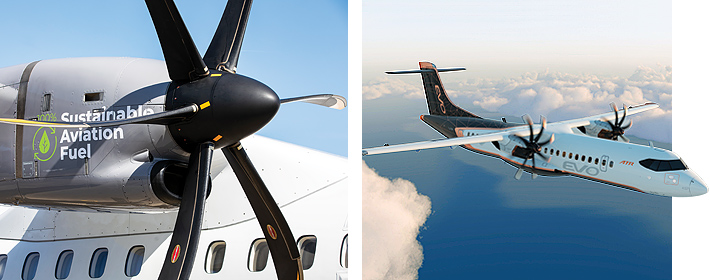
As airlines face growing pressure to decarbonise, ATR is accelerating its technological roadmap. Under the European Union's Clean Aviation programme, ATR leads two major projects, HERACLES and DEMETRA, to integrate hybrid-electric propulsion into future regional aircraft.
By 2030, ATR will fly a hybrid-electric ATR 72-600 demonstrator, making history once again.
Building on this research, the ATR EVO concept will redefine regional aviation for the mid-2030s, targeting:
With the EVO programme, ATR aims to deliver the next generation of low-emission regional aircraft while retaining the versatility that operators value today.
ATR has also become a global leader in Sustainable Aviation Fuel (SAF):
By the second half of this decade, ATR aims for full 100 per cent SAF capability across its fleet.
ELEVATING PASSENGER EXPERIENCE: ATR HIGHLINE
While most regional flights are short, passenger expectations in India are evolving. In response, ATR developed HighLine, a premium cabin concept offering business-jet-like comfort on turboprops. Featuring elevated interiors, wider seats, connectivity solutions and enhanced comfort, HighLine has already been selected by carriers such as Air Tahiti and Berjaya Air.
A notable innovation, the X-Space Table, launching with Air Cambodia, allows operators to transform a dual economy seat into a single premium seat in minutes, offering flexible layout options for evolving markets like India.
A FUTURE SHAPED BY REGIONAL MOBILITY
As India's aviation market is set to boom over the next decade, ATR forecasts a need for around 210 additional turboprops over the next 20 years, a conservative estimate that could grow further as the airport network expands. With its unmatched economics and lowest emissions, ATR is uniquely positioned to be the aircraft of choice for India's regional future.