



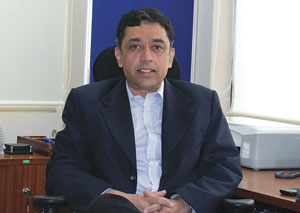
Ananth Ramaswami Managing Director, CAE India
SP’s ShowNews (SP’s): How do you view the opportunities for simulation and training in India?
Ananth Ramaswami (Ramaswami): We see bright future for simulation and training, and no shortage of opportunities globally, including here in India. Some parts of the global defence market are facing some very real and challenging fiscal restraints, while others like India have plans for growth in defence. In either case, defence forces are not going to accept anything that jeopardizes safety or readiness. The people in uniform all over the world are highly professional, and they have high expectations of themselves to not let readiness be impacted even in austere budget environments. CAE firmly believes that the increased and more efficient use of simulation is part of the solution to lowering costs without sacrificing readiness or capability, and we believe India’s defence forces need to adopt an increased use of high-fidelity simulation and training systems. Simulation offers a number of benefits, notably safety and cost advantages, which simply cannot be ignored. The increased cost of fuel, environmental impacts, and significant wear and tear on weapon systems all point to the greater use of simulation. More importantly, simulation is the ideal tool for mission preparation and rehearsal, which is critical for ensuring readiness and doing so both safely and cost-effectively.
SP’s: What needs to happen in India to shift more training to the virtual domain?
Ramaswami: Making the shift to more virtual training is not without investment, and not without challenges, the greatest of which may be changing behaviour. India’s defence forces need to be ready and willing to do business a different way. For example, India needs to consider training options such as government-owned contractor-operated or contractor-owned contractoroperated training centres, such as the HATSOFF helicopter training centre in Bengaluru. As a company focused exclusively on modelling, simulation and training, as well as a company who owns and operates more than 40 training centres worldwide where over 1,00,000 civil and military crew members train annually, we have some relevant experience both in developing world-class simulation technologies and applying those technologies efficiently and effectively.
SP’s: What emerging technologies are likely to impact the future of simulation?
Ramaswami: One of the definite trends we see globally is the desire to use simulation for mission preparation and rehearsal, which is critical for ensuring the readiness of defence forces. Another trend is the continuing desire for realism - in other words, to make the virtual world look and feel just like the real world. There are lots of pieces to this puzzle - some that are in CAE’s control and some where we are leveraging the technology curve of other industries, such as gaming technologies or display technologies. One of the emerging technologies that we see impacting the future of simulation is something we call a “dynamic synthetic environment”, which we are demonstrating here at Aero India. CAE has had an internal research and development programme over the past couple years aimed at making synthetic environments dynamic, persistent, open and scalable. Military customers have been telling us they need a fully correlated, interoperable and persistent dynamic synthetic environment. What defence forces want to do is have the ability to plan for missions using “what-if” analysis and decision-support tools, rehearse for missions in real-time, and then execute missions that will leave less room for surprise outcomes - and be able to do this in “real-time” and in “simulation”. In other worlds, the synthetic environment needs to be more like the real world, which is constantly changing. This kind of integrated, interoperable, immersive synthetic environment is also important for joint, coalition training, which will increasingly need to be done in a virtual environment because of the cost-efficiencies it can deliver.
SP’s: Has CAE initiated any steps in India to capture business generated by offsets?
Ramaswami: Last year CAE and Rossell India Limited established a special purpose company called CAE Rossell India Limited to address the needs of the market generated by offsets. This company is owned 74 per cent by Rossell and 26 per cent by CAE. We want to maximise business opportunities as well as technology transfer to India by leveraging CAE’s breadth of simulation technologies in line with the offset policy. We are in discussions with major OEMs from the United States, Europe and Russia to discuss ways to partner with them and help them meet offset obligations.