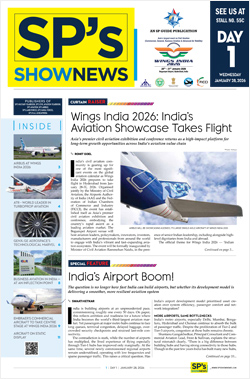





From fleet growth to ecosystem readiness, India is getting ready for the next aviation cycle

Despite India becoming the world's third-largest aviation market, GE Aerospace noted at Wings India 2026 that the country is still short of the critical engine volume needed to justify a dedicated global MRO facility. Vikram Rai, CEO, GE Aerospace (South Asia), during the MRO Roundtable explained that a viable business case typically requires 2,000-2,500 aircraft engines to ensure rolling capacity. While Indian airlines have ordered around 1,300 engines over the past five to six years, 1,196 powered by GE or CFM only about 550 GE and CFM engines are currently in operation domestically. Narrow-body engines, primarily CFM, typically require major performance restoration every four years. Rai emphasised that timing is crucial, as global MRO providers need assurance of sustained engine inflows before committing capital, highlighting the importance of fleet maturity and utilisation growth.
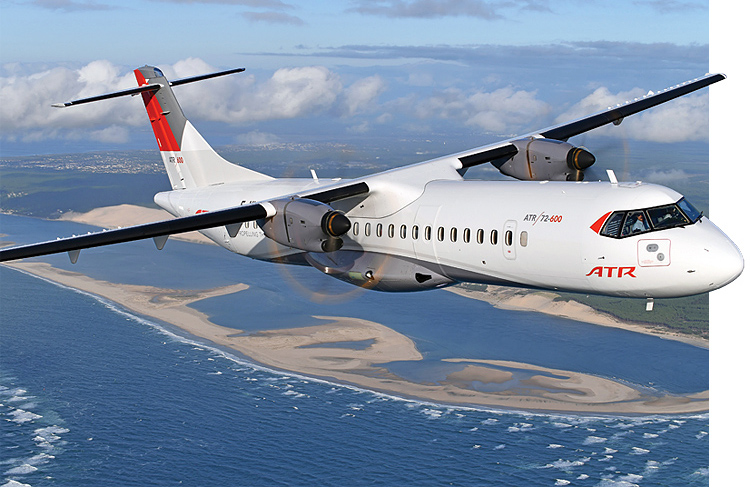
ATR's latest white paper, Exploring India's Connectivity Landscape, released at Wings India 2026, confirms that India's regional aviation market is fundamentally suited to turboprops. Using its MobilityMonitor platform, the study found that over 90 per cent of India's 4.6 billion annual inter-city journeys are under 400 nautical miles, the range where turboprops offer superior economics and lower emissions compared to regional jets. Only three per cent of inter-city travel is currently by air, indicating significant untapped demand. The report identifies up to 900 new domestic routes, with 420 ideally suited for turboprop operations, potentially serving an additional 35 million passengers. ATR estimates that many of the 90 million new passengers expected through UDAN-backed airport expansion can only be served efficiently by turboprops, reinforcing their central role in India's regional connectivity strategy.
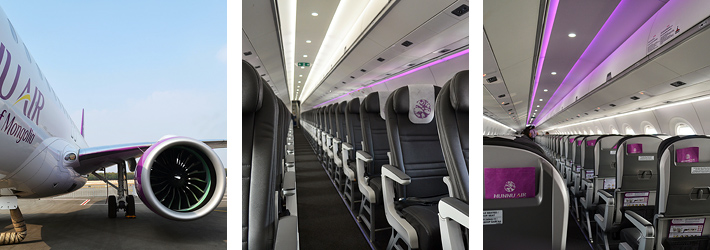
One of the most prominent aircraft at Wings India 2026 was Hunnu Air's Embraer E195-E2, branded the "Profit Hunter." Delivered in December 2025, the aircraft drew strong attention as part of Embraer's product showcase, competing with the Airbus A220 and Sukhoi Superjet SJ100 in the small jet segment. The aircraft arrived in Hyderabad on a nine-hour flight from Ulaanbaatar with a refuelling stop in Almaty, demonstrating its extended regional reach. Powered by Pratt & Whitney PW1900 engines, the E195-E2 offers reduced fuel burn and lower noise, cruising at Mach 0.82 with a regional range of nearly 5,556 km. Configured with 16 premium economy and 120 economy seats, the aircraft supports Hunnu Air's network across Central and East Asia, with charter links to India for religious tourism.
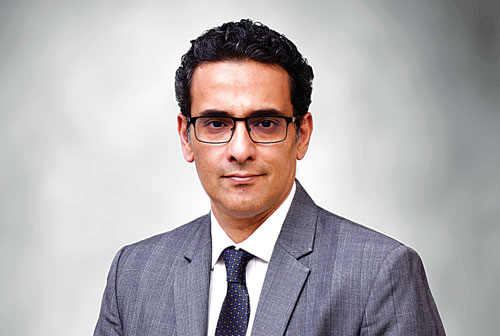
Thales reaffirmed its long-term commitment to India's aviation ecosystem at Wings India 2026, where it served as the Official Avionics Partner. The company highlighted its expanding role as a technology partner to Indian airlines, airports, and regulators, supporting major carriers such as Air India and IndiGo. Thales showcased its end-to-end focus on the passenger journey, from DigiYatra-enabled biometric airport solutions and Airport Operations Control Centres to advanced avionics and inflight entertainment systems. The company also outlined its growing capabilities in drones, counter-drone systems, Unmanned Traffic Management (UTM), and Air Traffic Management (ATM), aligned with India's future airspace needs. Localisation remains central to Thales' strategy, with ongoing investments in engineering centres in Bengaluru and Noida, expansion of its Gurugram MRO facility, and deeper supply chain partnerships. These initiatives align with Atmanirbhar Bharat and position Thales as a key enabler of India's aviation transformation.
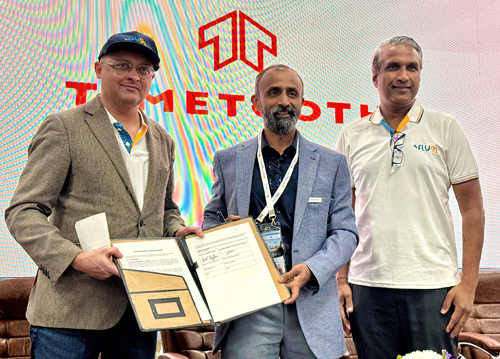
TimeTooth Technologies made history at Wings India 2026 by becoming the first Indian company to receive DGCA Indian Technical Standard Order (ITSO) certification for aircraft seating systems. This landmark approval positions TimeTooth as a certified domestic manufacturer and represents a major step forward for India's aircraft interiors and manufacturing ecosystem under Atmanirbhar Bharat. The company also signed a strategic MoU with Hindustan Aeronautics Limited (HAL) for the development and supply of pilot and co-pilot seating for indigenous aircraft and defence platforms. A separate MoU with regional airline Fly91 will support seating solutions for its expanding fleet under the UDAN scheme. These partnerships reflect growing airline and OEM confidence in Indian-certified products and reduce dependence on imports. The ITSO approval unlocks both domestic and global market opportunities, marking a defining moment for India's aircraft interiors sector.